Give reunions a little attention and a familiar greeting. The size of a goodbye or hello does not measure how much your baby loves you.
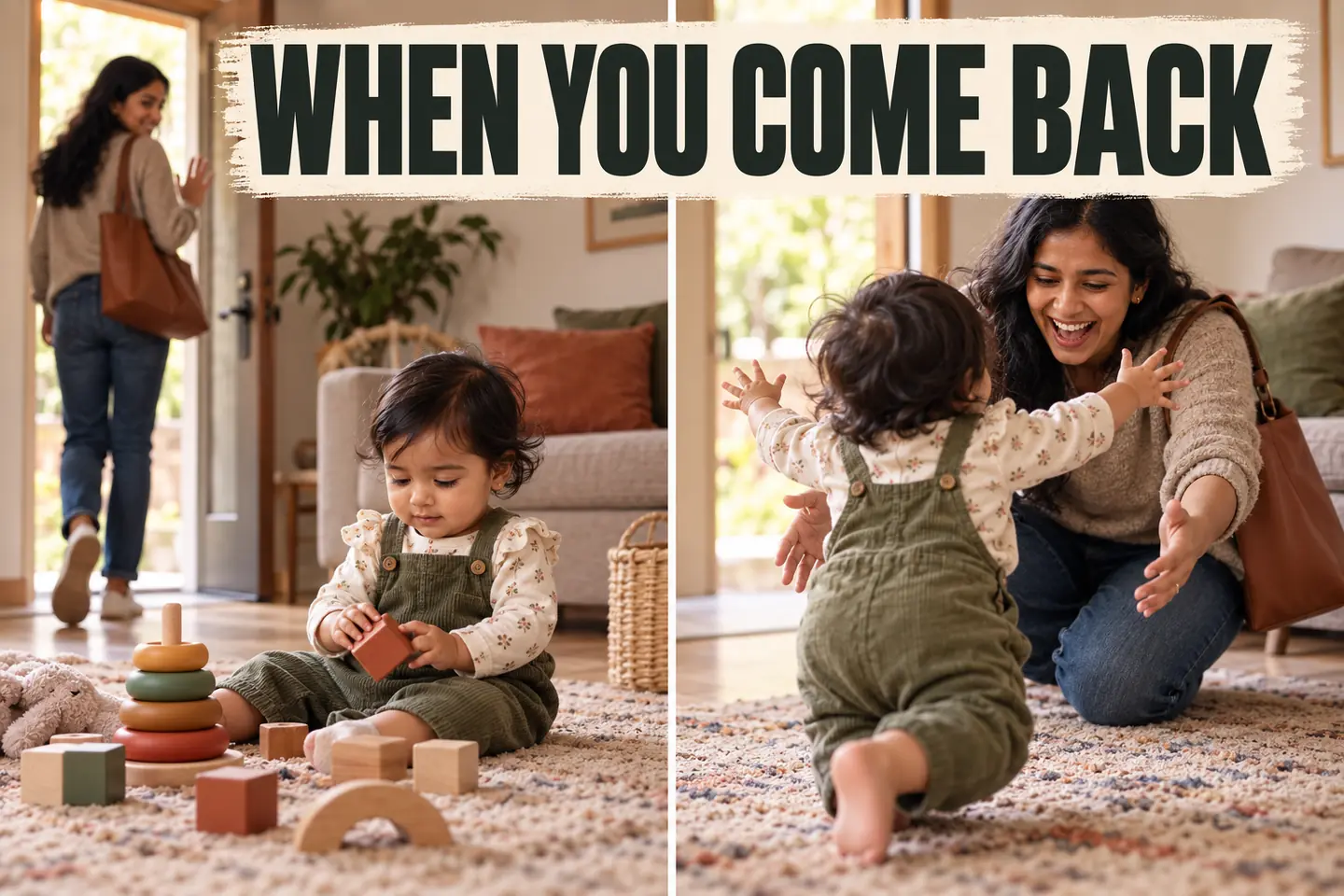
You leave your baby happily absorbed in a toy. Later, you walk back through the door and get the full welcome: kicking feet, raised arms, a bright face, perhaps an excited squeal. The goodbye barely registered. The return seems enormous.
Babies can respond strongly to seeing a familiar caregiver again, but not every reunion looks the same. What they were doing, how long you were away, who stayed with them, and how they feel in that moment all matter. A bigger hello than goodbye is not a calculation your baby is making about your absence.
Familiar people matter in everyday ways
Your voice, face, and usual ways of holding or talking to your baby are part of their ordinary experience. Returning brings those familiar interactions back into the room.
As babies grow, their responses to separation can also change. A baby who once waved you off may become upset at departures, while another remains comfortable with a familiar caregiver. The AAP and ZERO TO THREE describe separation concerns as part of many babies' development, with considerable variation in how they appear.
Why the two moments can look so different
At goodbye, your baby might be looking at a book with another trusted adult. At hello, you may be the most interesting new event in the room. The difference in attention alone can change what you notice.
Avoid turning the comparison into a test: “They didn’t cry, so they didn’t miss me,” or “They only want the other parent.” You cannot measure a relationship from a brief doorway reaction. There are many ordinary ways a baby can be comfortable with more than one person.
Build a small reunion ritual
Put down what you are carrying when you safely can. Get close enough for your baby to see and hear you, and offer a familiar greeting: “Hello, I’m back. It’s lovely to see you.”
If they reach for you, respond with a secure pickup. If they are finishing a game, sit nearby for a moment. You do not need to interrupt them to make the reunion count. A quiet hello at the edge of play can be just as considerate as an enthusiastic cuddle.
Ask the caregiver about practical needs too. An excited baby can still be hungry or overdue for rest, and a long greeting is not always the best next activity.
When coming home brings tears instead
Some babies cry on seeing a parent again. Before interpreting the tears, check the immediate situation: a transition, fatigue, hunger, or a wish to be held. Offer comfort and let the moment settle.
For future departures, use a brief, clear goodbye with a familiar caregiver taking over. Sneaking away may seem easier in the instant, but a predictable leave-taking gives you a routine to practice together. Adapt the plan if separations repeatedly remain difficult.
Keep the relationship bigger than the greeting
There is no required welcome-home reaction. Smiling, watching, reaching, crying, and continuing to play can all occur in ordinary family life. Persistent distress across separations is worth discussing with your clinician or childcare team.
Enjoy the big welcome when it arrives. On quieter days, offer the same steady message: you have returned, you are available, and there is time to find each other again.
Further reading
ZERO TO THREE: Separation Anxiety
AAP: Emotional and Social Development, 8 to 12 Months
Adapt these ideas to your family. For concerns about your child’s health or development, talk with a qualified professional who knows them.

Daniel Brooks
Play, connection & family life
About this author