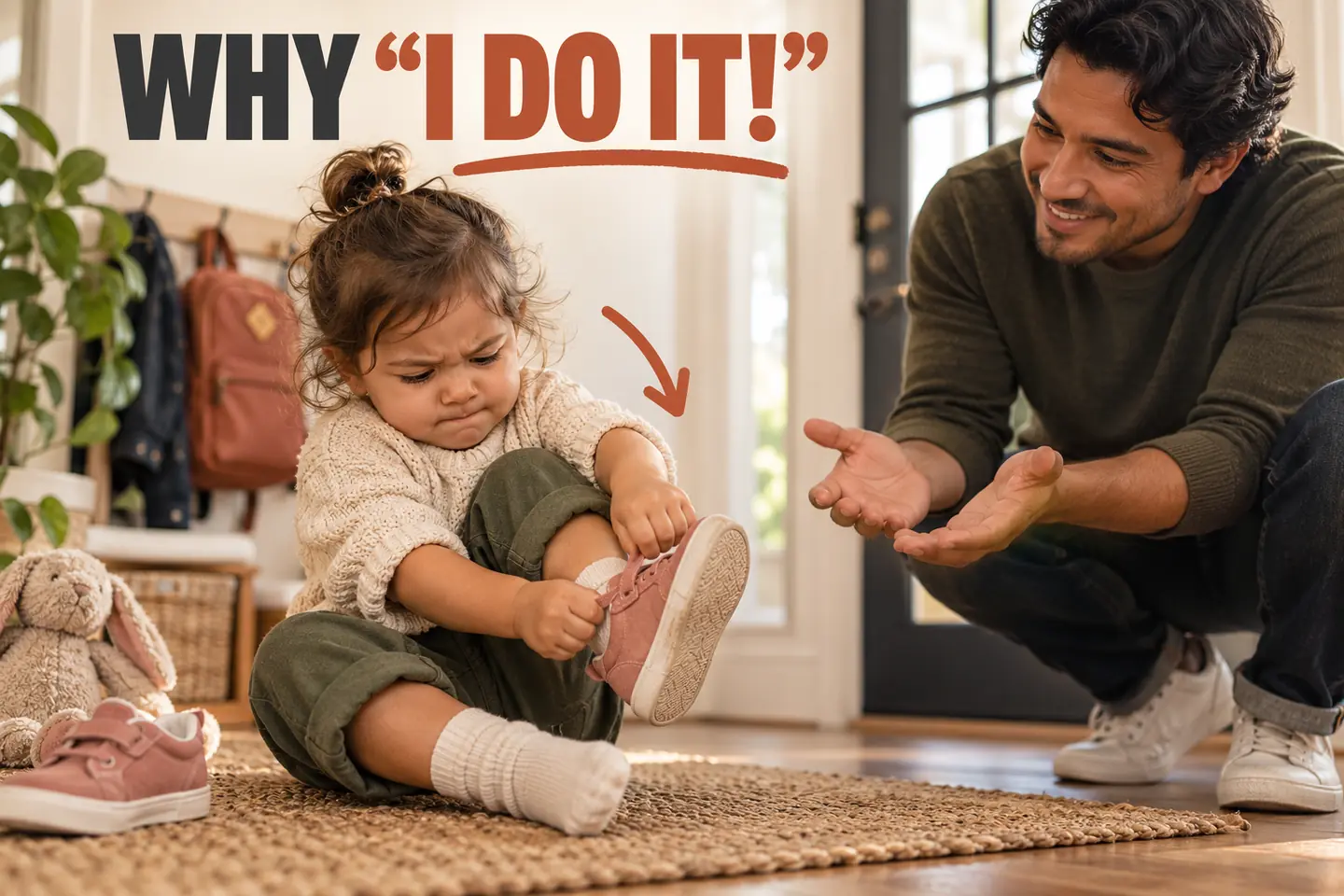
Offer help with one part of the task, leaving a meaningful part for your child. Practice independence when there is enough time to try.
The shoe is nearly on. You reach to straighten the heel. “NO! I DO IT!” Your toddler pulls it off, determined to start again while you look at the clock.
Refusing help can reflect a wish to participate and make decisions even when a task still exceeds a young child's skill. Frustration can arrive in the gap between “I want to” and “I can.” The useful response is often to divide the job differently, rather than choosing between doing everything and refusing to help at all.
Find the part your child wants to own
Before reaching in, watch what they are attempting. They might want to pull the strap rather than position the whole shoe, pour from the jug rather than hold the cup, or choose the shirt rather than manage its buttons.
Ask something small: “Do you want me to hold the shoe while you push your foot in?” This leaves a visible part of the work with your child. A vague “Let me help” can sound like the whole task is about to disappear from their hands.
Offer the smallest useful assistance
You can support the setup without completing the action. Loosen the opening, steady the paper, or put the reachable item closer. Then move your hands back and allow time.
If another step is needed, show it once or describe it briefly. The CDC recommends simple directions suited to a child's abilities. One instruction—“Pull this tab”—is easier to use than a running commentary on every mistake.
For a familiar task, waiting may be the help your child needs. For an unfamiliar one, a calm demonstration can prevent repeated frustration. Choose based on what you see, not a rule that independence always means adults stay completely out.
Leave practice for a moment with room in it
A weekday departure is a difficult time to master a complicated fastening. You can say, “You can try once more. Then I need to help so we can leave.” Follow through gently if the time arrives.
Later, leave the shoes beside you during a relaxed moment and invite another attempt. Practicing at home without the coat, bag, and deadline gives both of you a different experience of the same skill.
Avoid promising unlimited time when it is unavailable. A clear, kind limit is more workable than silently growing angry while waiting.
Keep safety tasks in adult hands
A child can help with a routine without taking responsibility for its safety. They might place their arms through car-seat straps while you complete and check the fastening. They can hold a toothbrush while you provide the brushing help they need.
Name the division: “You choose the cup. I pour the hot drink where you can’t reach it.” You do not need to frame essential adult care as a choice.
Notice the effort without making help a failure
Try, “You kept working on that strap,” or “We did different parts.” Avoid praising independence in a way that makes asking for help feel embarrassing. Being able to request support is useful too.
If a task repeatedly leads to distress, make it easier, check for discomfort, or ask whether your expectations match your child's abilities. The next “I do it” can be an invitation to share the job more thoughtfully—not a challenge you have to defeat.
Further reading
AAP: Emotional Development in Two-Year-Olds
CDC: Tips for Giving Directions
Adapt these ideas to your family. For concerns about your child’s health or development, talk with a qualified professional who knows them.

Daniel Brooks
Play, connection & family life
About this author