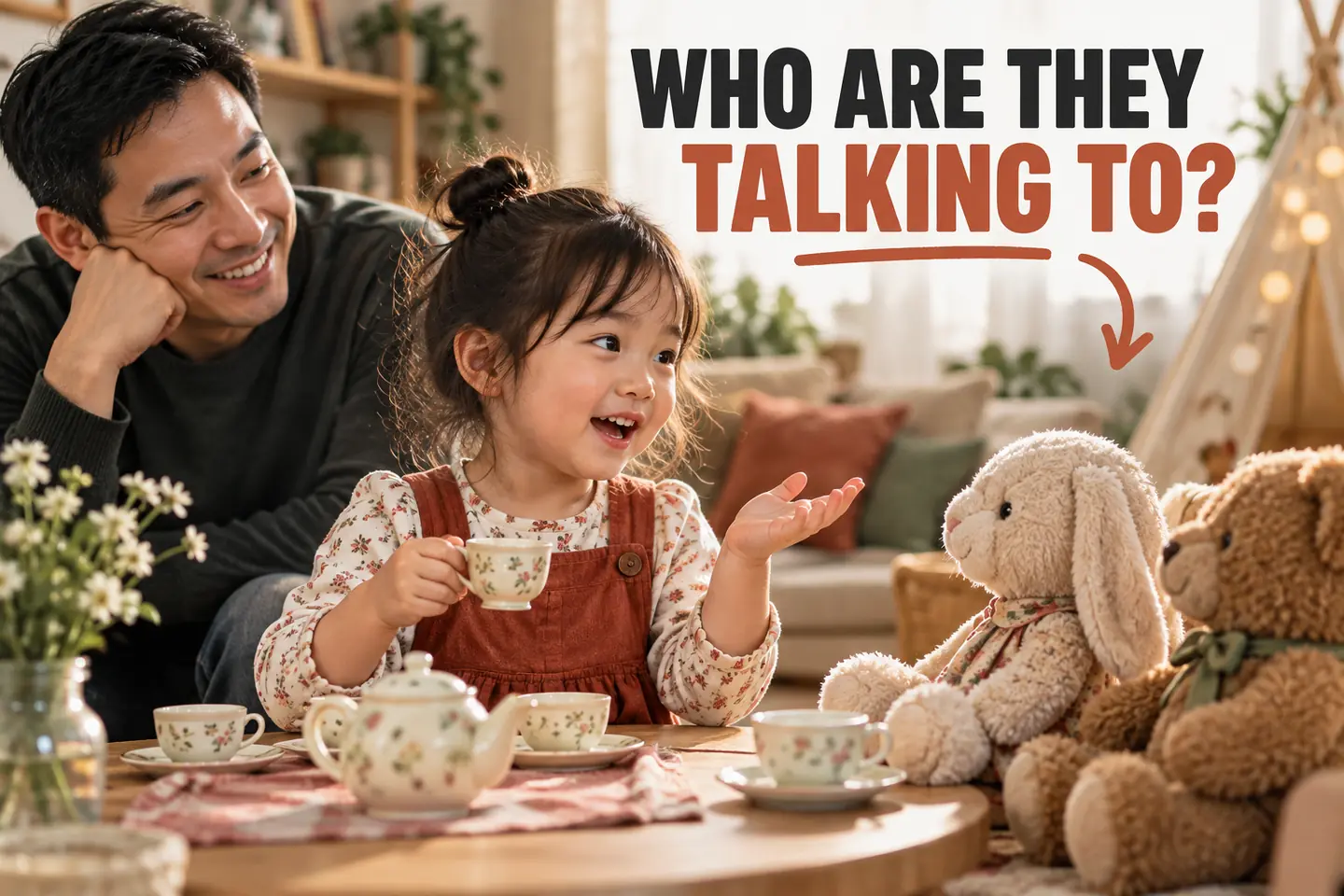
Let your child lead the pretend conversation. Listen, join when invited, and avoid treating a toy’s story as a literal report of your child’s thoughts.
Teddy has refused his lunch. The rabbit wants another cup of tea. Your child explains the rules to both of them with the seriousness of someone running a very small household.
Talking to toys can be part of pretend play, where a child gives an object a role and creates a situation around it. They may try out familiar phrases, invent a story, or explore what happens when different characters want different things. An animated conversation with a stuffed animal does not, by itself, mean a child cannot tell pretend from everyday life.
The toy can become almost anyone
In one game, a bear is a baby who needs a blanket. In the next, it is the teacher leading everyone to the garden. The rules can change because the child is making them.
The AAP describes pretend play as an opportunity for imagination and practicing different roles. The CDC also includes pretending to be another person or character among common four-year social milestones. Earlier forms of pretend play may be much simpler, such as offering a toy a drink.
Listen for the story without decoding every line
You may hear your own words repeated. You may also hear something from a book, a sibling, childcare, or a completely invented conversation. A toy being told off does not automatically reveal how your child feels about your parenting.
If you are curious, ask an open question: “What is happening with Bear?” Avoid steering toward a conclusion—“Is Bear sad because Mommy shouted?”—that the child has not offered. Their answer belongs to the play, and you can let it stay there.
If your child directly tells you that someone hurt or frightened them, take the disclosure seriously and listen calmly. That is different from interpreting an imaginative scene as evidence on its own.
Join at the level your child invites
You might be asked to hold a cup, speak for a character, or simply watch. Follow that invitation before proposing a new plot.
Try, “Where should I sit?” or “What does Rabbit want me to do?” If your child changes the rules, you can go along where it is safe and comfortable. The purpose is shared play, not a consistent script suitable for a stage production.
Sometimes the best contribution is to stay nearby while your child continues alone. A private conversation between a child and a toy does not always need an adult audience.
Keep the materials simple
A few age-appropriate soft toys and large toy dishes can support plenty of stories. Avoid small loose items around children who mouth objects, and check toys for damaged parts. You do not need to buy a new themed set each time the story changes.
Ordinary props can work when they are safe for the child's age. A small cloth might become a picnic blanket for a bear; a cardboard box might be the bus stop. Let the child's idea decide what is useful.
Leave room for different kinds of play
Some children love long character conversations. Others prefer building, moving, drawing, or playing alongside an adult. A single activity does not measure imagination or language ability.
If you have broader concerns about communication or development, bring those to your child's clinician. Otherwise, enjoy the small world taking shape on the rug. Ask for a seat at the tea party when invited—and accept that Teddy may be in charge of the menu.
Further reading
AAP: Pretend Play and Children’s Imagination
Adapt these ideas to your family. For concerns about your child’s health or development, talk with a qualified professional who knows them.

Emma Bennett
Everyday parenting & big feelings
About this author