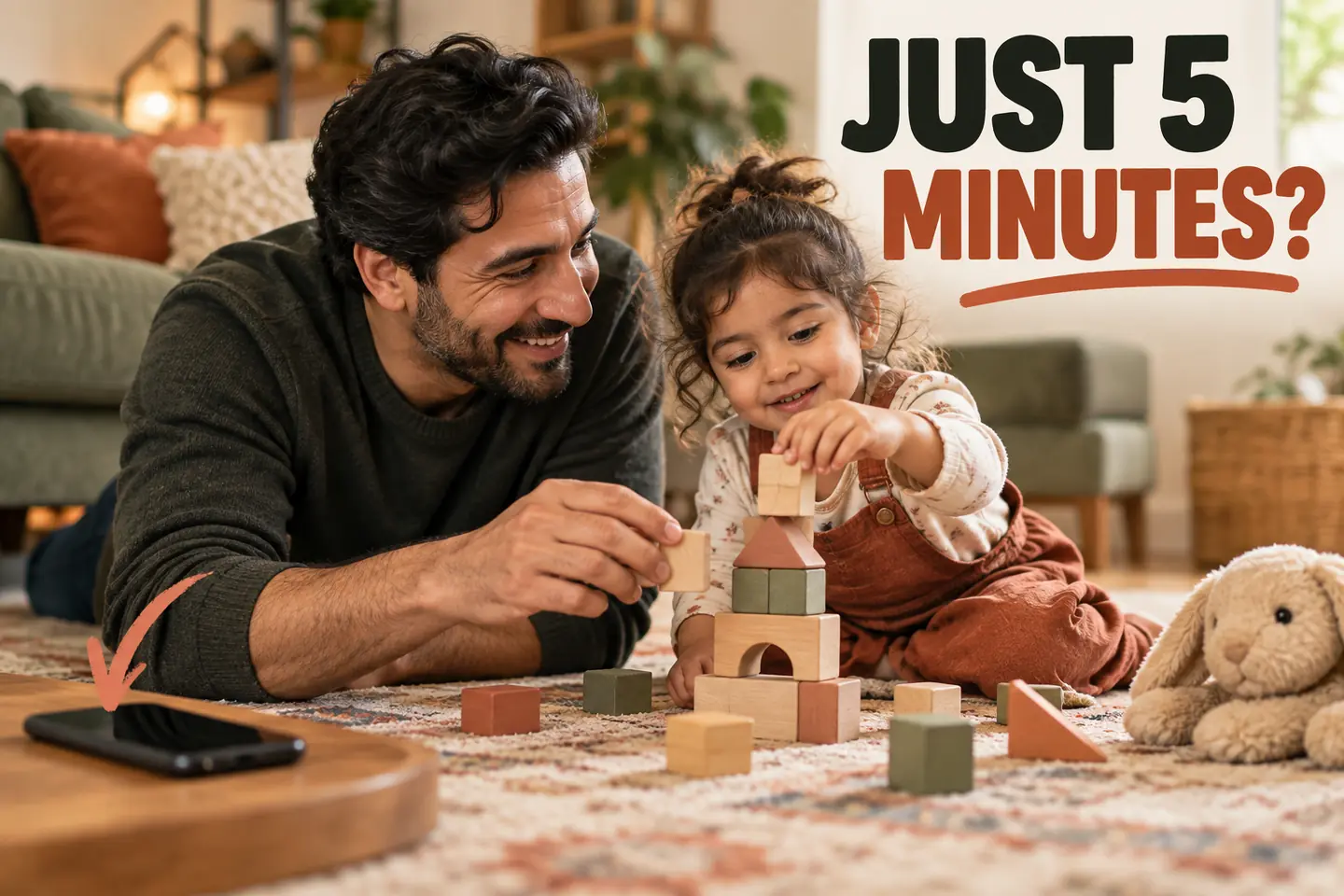
Set aside a manageable pocket of time, put distractions away, and let your child lead a safe activity.
You don’t need an elaborate activity tray to spend connected time with your child. You can begin with the blocks already on the floor, a few crayons, or a pretend shop made from empty boxes.
The idea is to reserve a small pocket of time when your child gets to lead and your attention is available. Start with five minutes if that fits your day. You can stay longer when you have the time; what matters here is giving your child your attention.
Make the invitation simple Try: “I have a few minutes to play. What would you like us to do?” Offer two available, safe options if an open choice feels overwhelming. Put your phone out of reach when practical, and choose a moment when you’re not also cooking or supervising a hazard.
The CDC describes child-led play as time to follow a young child’s lead, notice what they’re doing, and use positive attention. Its guidance suggests building a regular special playtime into the day.
Follow before you teach If your child stacks a small block under a large one, let the experiment happen as long as it’s safe. You don’t have to turn every moment into a lesson on balance, colors, or counting.
Try describing an action: “You’re making a long road.” If your child makes up a story, join the part they offer you. Resist correcting the imaginary rules just because they would not work in real life.
Leave room for silence Attention doesn’t require constant commentary. Sit, watch, smile, and respond. Some children enjoy a running conversation; others prefer a quieter companion.
If you catch yourself asking question after question, pause. “What color is that?” can become another test. “You chose the bright green one” leaves your child free to continue.
End with a clear, warm transition When your time is nearly over, explain what comes next. “I enjoyed building with you. After we park these two cars, I’m going to start dinner.” If your child is disappointed, acknowledge it without promising time you don’t have.
Choose a realistic time to try again. A short routine you can return to is more useful than an ambitious promise that makes you feel guilty. If today falls apart, there will be another ordinary moment to begin.
Further reading
Adapt these ideas to your family. For concerns about your child’s health or development, talk with a qualified professional who knows them.

Daniel Brooks
Play, connection & family life
About this author